What this investigation is
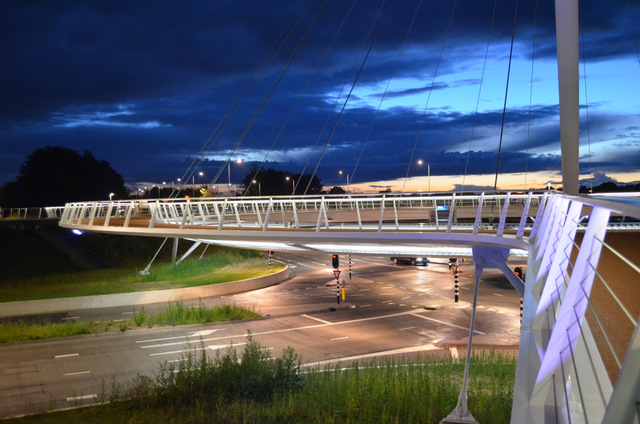
Hovenring separates slow traffic from motor traffic vertically. Its circular deck hangs from a central pylon, while the road intersection passes underneath. The design turns a difficult junction into a recognizable piece of cycling infrastructure.
What the sources establish
- ipv Delft lists a 70-metre central pylon. Its Dutch page conflicts on deck diameter: the narrative says 75 metres while the specification block says 72 metres.
- The deck is 5 metres wide and supported by 24 steel stays.
- The intersection beneath was lowered by 1.5 metres to keep cycle approaches comfortable.
- The bridge was delivered in 2012; ipv Delft lists an execution cost of €6.3 million.
- It is for cyclists and pedestrians, not motor vehicles.
What to notice
- Look at how the 24 stays distribute the circular deck’s load back to one pylon.
- Notice that the roadway was lowered as part of the solution; the bridge geometry is not working alone.
- Approach from a safe cycle or pedestrian route rather than trying to observe it from the motor intersection.
Evidence limits
The designer’s own page conflicts on deck diameter, so neither 72 nor 75 metres is treated as settled here. John Tarantino’s verified CC BY-SA 3.0 photograph is displayed above without crop and with attribution; it is presented with the creator and licence attribution supplied by Wikimedia Commons.
Sources
- 1
- 2
- 3